Online shop
Your business is not a template.
Your shop should not be either.
A storefront designed around how you actually sell, hosted in Europe, yours outright. Custom development used to be an agency budget away. It is not anymore.
The idea
This is what custom looks like
The shop in the film is not a theme with the colours changed. Every page was designed around the products it sells. This is Headless Commerce: the storefront is fully yours, and behind it a commerce engine that has been running shops since 2011 handles payments, tax and stock, the parts where you want boring reliability, not originality.
The problem
A theme built for everyone fits no one
Your prices work a certain way. Your customers ask for things other shops never hear. The parts of your business that make people buy from you instead of anyone else are exactly the parts a ready-made theme does not cover. So you bend the business to fit the template, or you bolt on plugins until it creaks. Either way, the shop ends up looking like everyone else’s and working like no one’s.
The economics
What custom actually costs now
The assumption is that custom means agency money, so small shops settle for a theme. Compare what the money buys.
A high-end template, implemented by an agency
Typically €5,000 to €15,000 to configure and customise a theme, plus platform fees on every sale for as long as you trade. The features that do not fit the theme are cut from the project, not from the invoice.
A custom storefront, with me
From around €5,000, one-off. Every page designed around how you actually sell, on infrastructure you own, with no percentage of your revenue going anywhere. The checkout underneath is proven open-source commerce software, not custom code. Payments and tax are the one place you do not want originality.
Why this is possible
Custom development stopped being a luxury
The honest answer is AI. AI-assisted development lets one senior builder do what used to take an agency team, without the agency overhead. It is the same orchestration approach Crystallized Intelligence builds for clients in other trades, applied to building shops. No magic involved: the design decisions, the security review and the responsibility stay human. The repetitive work is what got faster.
Where things live
European from the checkout to the invoice
Before
Customer data spread across an American platform, an American payment processor and an American analytics script, with compliance treated as paperwork rather than geography.
After
Hosting in France, payments through a Dutch provider, prices in euros, legal pages written for an EU seller. The data stays under European jurisdiction because every part was chosen for it.
Fulfilment
Four ways to fill a shop
Templates assume one way of selling. Real businesses rarely have just one. The storefront does not care where stock lives: it asks the commerce engine for products, prices and availability, and that engine can be fed however suits the business. These mix, too.
-
You hold the stock
Stock levels, variants and shipping rules live in the shop. The warehouse is yours, or your logistics partner’s.
-
Made on demand
Nothing exists until someone buys it. Good for designs, merchandise, and testing whether an idea sells before committing money to it. This is the route I took for my own experiment.
-
Your supplier’s platform
If your wholesaler or supplier exposes an API, their catalogue, prices and stock levels can be pulled in and kept in step automatically.
-
A trade catalogue
Business customers who log in to see their own negotiated prices, order against a VAT number, and request a quote or raise a purchase order instead of paying by card.
The work
What a shop needs before it can open
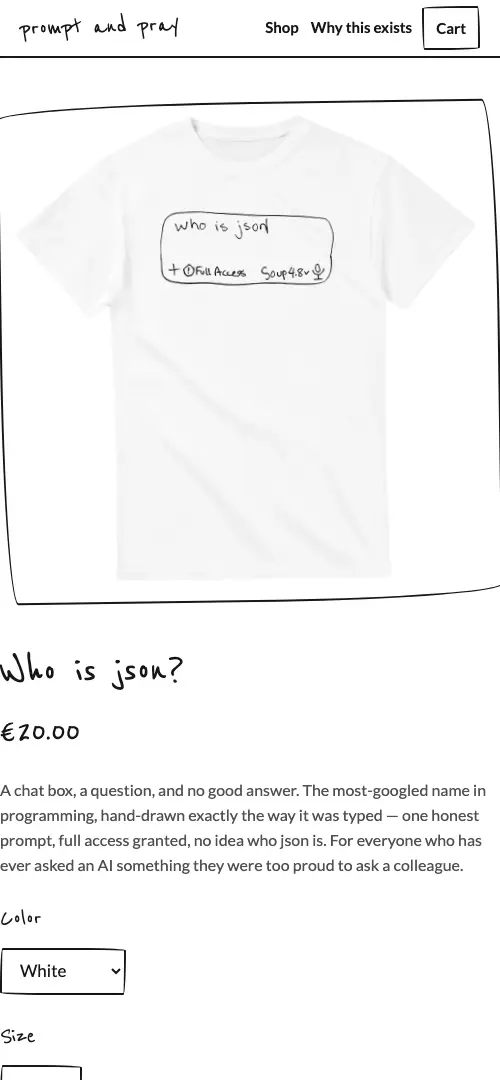
A catalogue with a buy button is not a shop. A shop is a cart that survives a refresh, a checkout that gets the tax right, and pages a screen reader and a search engine can both make sense of. Every screenshot below is from prompt and pray, a real shop built exactly this way.
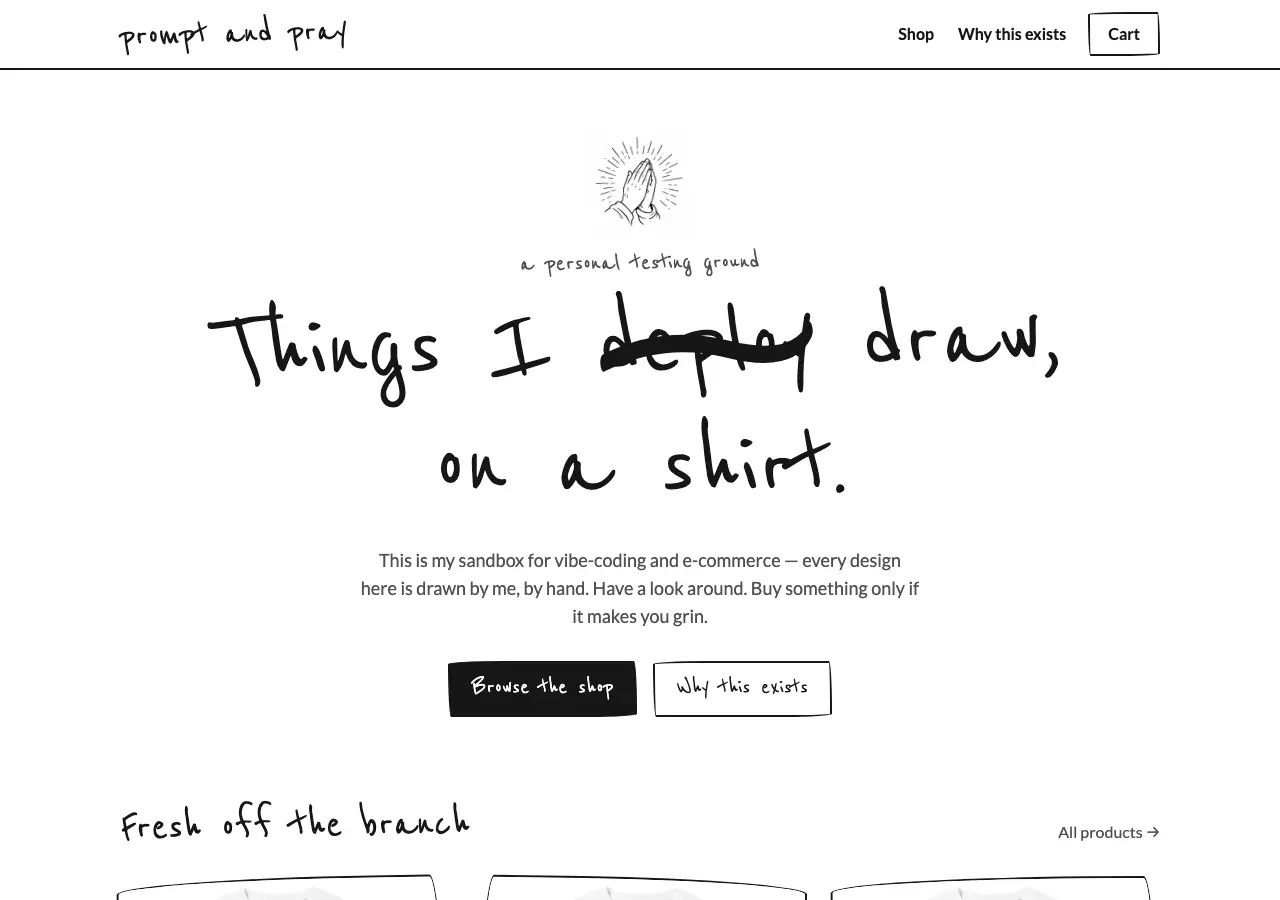
A storefront drawn for one shop
Fast static pages, generated from the live catalogue. Nothing sits between the customer and the page: no theme engine, no page builder, no database call on every visit. The hand-drawn look you see here is just an example. With a custom designed Headless front-end, imagination is the limit.
- Static and fast
- Built from the live catalogue
- No theme engine
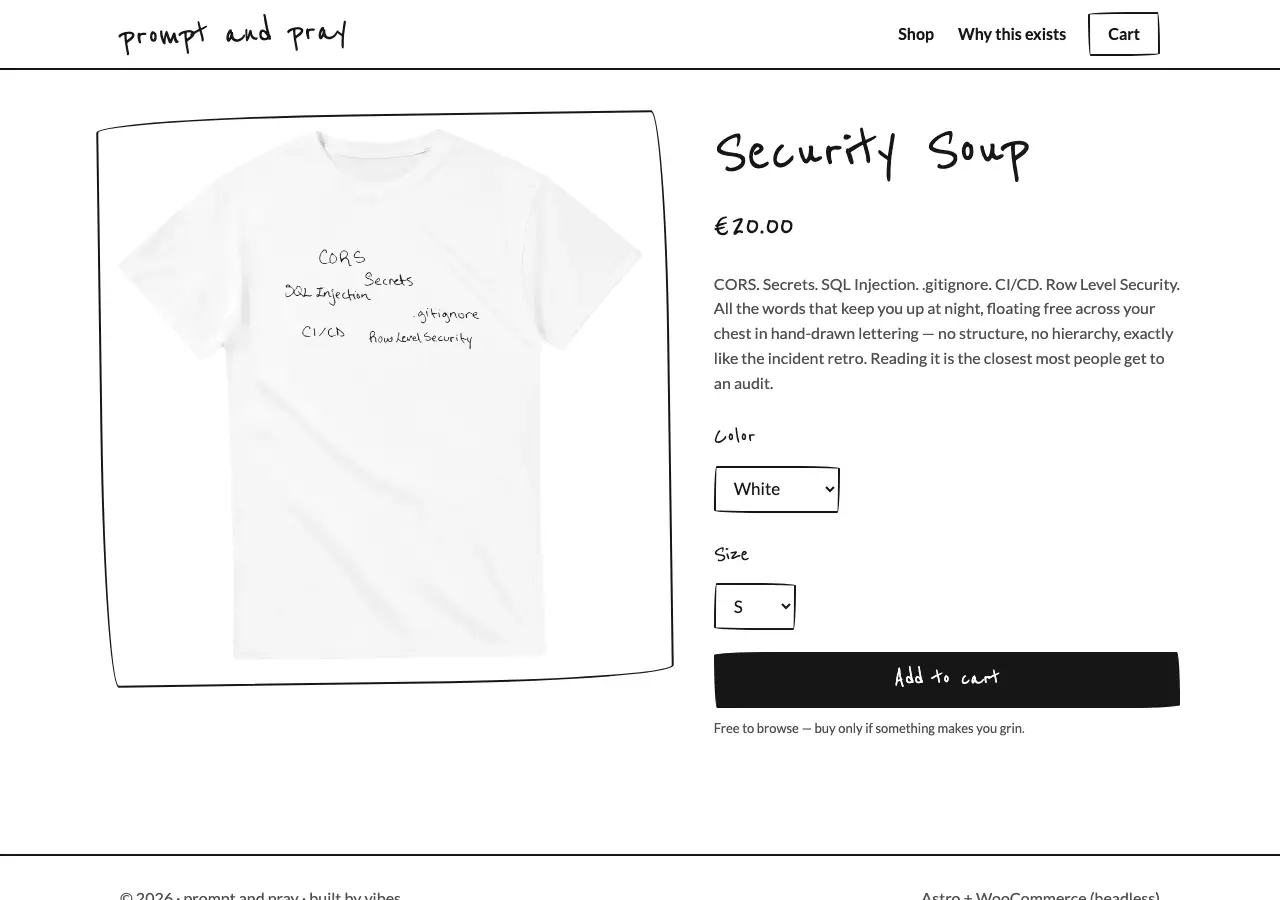
A cart that keeps secrets
The cart and checkout talk to the commerce engine through a server-side proxy, so the session token never reaches the browser. The cart survives a refresh, and the sensitive parts stay where nobody can tamper with them.
- €20.00
- Add to cart
- Session stays server-side
Payments and tax, taken seriously
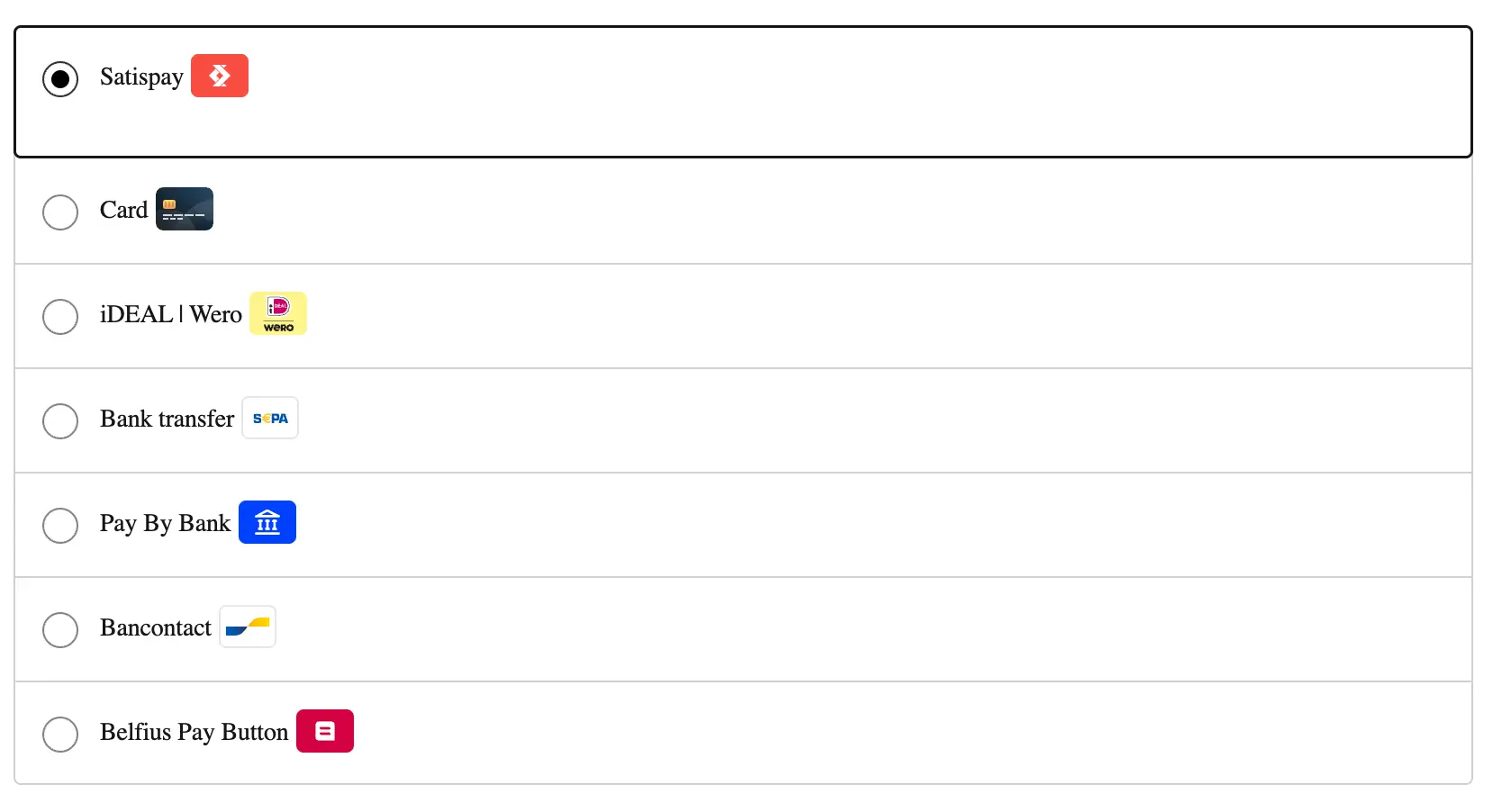
Cards, plus the local methods people here actually reach for: Satispay, Bancontact, iDEAL and Wero, SEPA transfers, even a Belfius button. VAT rates by country and invoices an accountant will accept, all handled by the commerce engine, which has been doing this since 2011.
- VAT 17 %
- Mollie (EU)
- No platform fees
The work you cannot screenshot
Most customers will meet the shop one-handed, on a phone, and it has to work there as well as on a desk. Keyboard, focus, contrast and reduced motion to WCAG AAA. Canonicals, a sitemap and product data search engines can read. A full security review: input validation, no secrets client-side, hardened endpoints. Invisible when it is done right.
- Mobile first
- WCAG AAA
- Hardened endpoints
The setup
All of it configured before you open
None of it is exciting and all of it is needed on day one. You should not be reading tax documentation or debugging email deliverability the week you open.
-
Languages
The whole shop in as many languages as you sell in. Product data, checkout and emails included, not just the menu.
-
Transactional email
Order confirmations, dispatch notices, refunds and password resets, sent from your own domain and passing SPF and DKIM.
-
Tax and VAT
Rates by country, EU cross-border thresholds, and invoices that satisfy an accountant.
-
Payments
Cards, plus the local methods people here reach for: Payconiq, Bancontact, iDEAL, SEPA.
-
Shipping
Zones, weights, rates and pickup points, wired to whichever carrier you already use.
-
Legal pages
Terms, returns, privacy and cookie notices written for an EU seller, not translated from an American template.
-
Accounts and orders
Customer logins, order history and re-ordering, with a back office your team can run without training.
-
Measurement
Privacy-first analytics that tell you what is selling without needing a cookie banner.
Who builds it
Crystallized Intelligence

An AI consultancy in Luxembourg run by Aisling McCaffrey. EU-based and GDPR-first by default, so your data and your customers' data stay on sovereign, EU-hosted infrastructure. This shop is being built the same way, in the open.
Thinking about selling something?
Tell me what you want to sell and to whom. I will tell you whether this is worth building for you, or whether a hosted platform is the better answer.