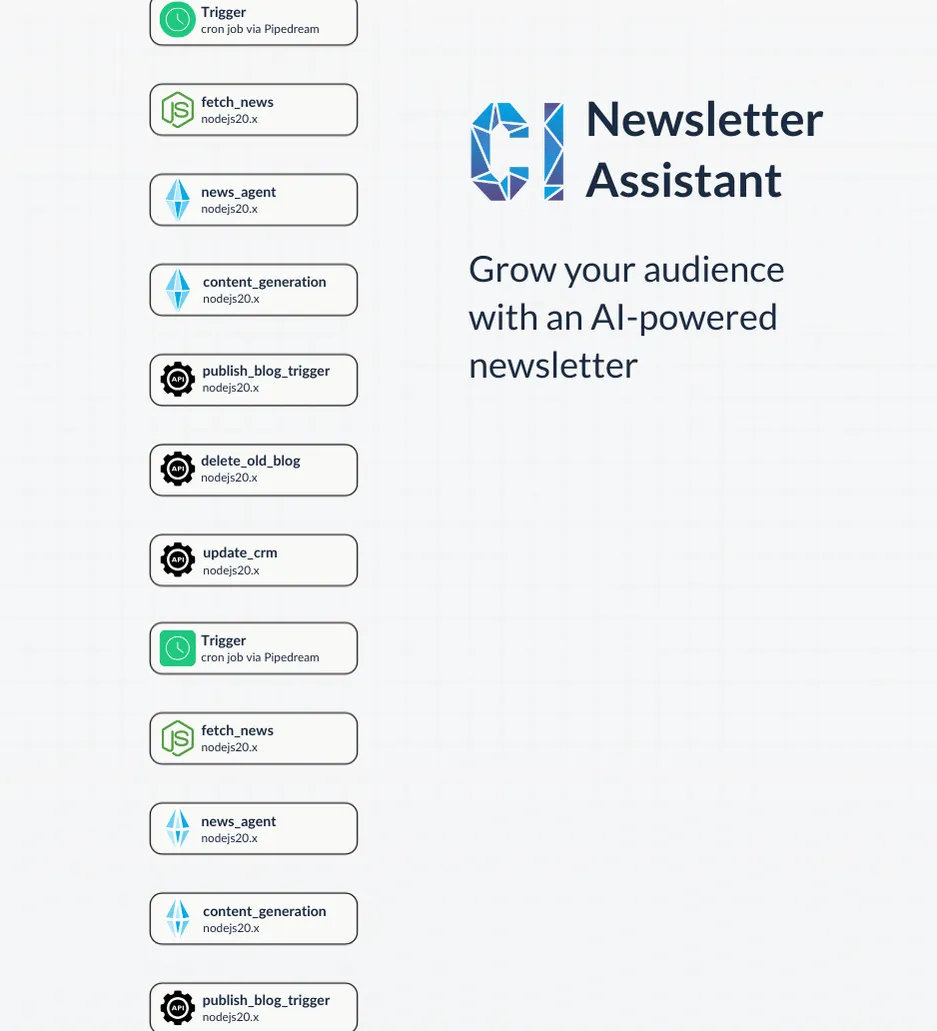
Newsletter Assistant
AI curates, summarizes, and formats a daily or weekly digest automatically.
For Small & Medium Enterprises
AI-powered workflows for SMEs in Luxembourg that save time, cut costs, and help your team focus on growth. No enterprise-scale commitment required.
Book a pre-discovery call"Big companies spend months cleaning data before they can start. You don't have that problem."
With less data, we scope every detail from day one — which is exactly why a focused Luxembourg SME can ship a working AI workflow in weeks, while large enterprises are still cleaning their data. Being small isn't a limitation. It's a superpower.
Most Luxembourg SMEs start with one workflow and grow from there. Here are the ones that deliver the fastest ROI.
Every engagement starts with understanding your business. No cookie-cutter solutions.
Explore real AI workflows you can use today — no commitment required.
Less than the headlines suggest. Most SME obligations are transparency-only. Heavier compliance only applies if you build or deploy AI in "high-risk" categories like recruitment or credit scoring.
Less than the headlines suggest, for most SMEs. The Act's strictest rules apply to "high-risk" AI systems used in things like recruitment screening, credit scoring, and education assessment. If you're not building those, your obligations are mostly transparency: disclose when content is AI-generated, label chatbots as chatbots, that kind of thing. The Act also includes specific support for SMEs, including simplified documentation and priority access to regulatory sandboxes. The harder question is what counts as "high-risk" for your specific use case. We help SMEs make that determination quickly so the conversation can move from worry to practical next steps.
No. The Act includes concrete reductions for SMEs: proportional fees, free regulatory sandboxes, capped fines, and simplified documentation forms designed for smaller providers.
No. The Act explicitly recognizes that SMEs can't absorb the same compliance burden, and it includes several concrete reductions. Conformity assessment fees must be proportional to the size of the provider. Regulatory sandboxes are free for SMEs and use simpler procedures. Maximum fines are capped at the lower of two thresholds for SMEs, rather than the higher one used for large companies. The Commission also has to publish simplified documentation forms specifically for SME use. Compliance still takes effort, but the rules were not written on the assumption that every provider has a legal department.
Something boring that costs hours every week, not the exciting customer-facing chatbot. Pick an internal task with a measurable time cost and a low cost of failure.
Something boring that costs hours every week. Not the exciting customer-facing chatbot. The invoice-routing thing. The "we manually copy data from emails into our spreadsheet" thing. The "we spend three days a month preparing the same report" thing. First projects should be invisible to your customers, because the cost of failure is internal embarrassment rather than reputational damage, and the time savings are easy to measure. Once a couple of those have run successfully for a few months, the team has built the muscle and the confidence to take on something more ambitious. Skipping straight to the ambitious project is how most SME AI initiatives quietly die.
In time, money, and quality, in that order. Pick one metric in each category, measure it for a month before AI goes in, then measure again at three and six months.
In time, money, and quality, in that order. Time is easiest: pick a task that takes a measurable number of hours per week, automate part of it, count how many hours you save. Money follows if the time saved gets reallocated to revenue-generating work or if you avoid hiring for capacity you no longer need. Quality is the slowest to show up but often the most valuable: fewer errors in invoices and more consistent reporting. Pick one metric in each category before you start, measure it for a month before any AI goes in, and measure it again at three and six months. If the numbers move, the project worked. If they don't, the project didn't.
Book a free 20-minute pre-discovery call. No commitment, no jargon — just an honest conversation.
Book a pre-discovery call